

Curators: Florencia Portocarrero and Irene Gelfman
This year’s focus is on emerging talent and experimentation. The space—traditionally dedicated to tributes and exhibitions by established artists—is transformed to spotlight emerging artists selected from participating galleries.
The curators, Florencia Portocarrero and Irene Gelfman, aim to present a fresh proposal that reflects new perspectives and contemporary practices within the fair.

Artists’ Bios:
Pierina Másquez Limo (Chiclayo, 1993) is a visual artist and educator. She lives and works in Lima. Her practice addresses the relationships between the body, desire, and collective organization, shaped by experiences of internal migration, working-class memory, and domestic labor.
Through textiles, ceramics, drawing, and expanded painting, she develops spatial devices that activate intimacy as a political field. Her work articulates situated feminism and speculative imagination to challenge normative models of gender, motherhood, and productivity, exploring forms of affective unionism from a transfeminist and class-based perspective. Her solo exhibitions include Sindicato de mujeres invisibles (ICPNA, 2025) and Hay algo que necesita ocultarse para que otros puedan existir (Crisis Galería, 2023). She has participated in numerous group exhibitions in Lima, Berlin, Paris, and Mexico City. In 2025, she was selected for the Gasworks residency in London.
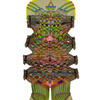
Fátima Rodrigo (Lima, 1987) is a visual artist working with installation, sculpture, textiles, sound, and scenography. Her practice investigates how European modernism was appropriated and re-signified in Latin American popular culture, understanding it as a contested field shaped by processes of appropriation, erasure, and reconfiguration. She questions binaries such as avant-garde/tradition and center/periphery.
Drawing from mid-20th-century music television and entertainment industries, she recreates geometric stage designs and ornamental motifs using beads, sequins, metallic threads, and industrial textiles. These materials—often associated with the decorative or feminine—become critical tools to destabilize modernist purism, reveal its hierarchies, and expose the erasure of Indigenous visual languages. Her recent research highlights the role of women and queer performers in the circulation of avant-garde aesthetics. Her work has been presented at the Liverpool Biennial (2023), Sydney Biennale (2020), Ars Electronica (2020), and Mercosur Biennial (2025), and is part of the collection of the Museo de Arte de Lima (MALI). In June 2026, she will present a solo exhibition at Museo Tamayo (Mexico City).
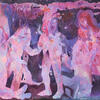
Verovcha (Lima, 1994) lives and works in Cusco, Peru. Her practice explores the body as a porous vehicle that destabilizes the illusion of separation, situated between form and overflow, where the figure spills into relation and reveals its fertility.
Through an interstitial approach, she develops a material language that activates the permeability of contours and opens the body toward an experience that exceeds the human. She works in dialogue with Kutichi, a textile design project developed with traditional weavers, where the Andean loom informs her research on material memory and embodiment. Her work interweaves painting, textiles, embroidery, and ritual actions, drawing on a sensibility close to tantric geometry. She has presented solo exhibitions at Paseo Lab (now Mueve Galería) and participated in group shows at ICPNA and Centro Cultural PUCP, as well as in Mexico and Dubai. In 2024, she was an artist-in-residence at Delfina Foundation (London) with the ARTUS grant. In 2025, she was a finalist in the MUCEN National Painting Prize. Her work is part of the collections of Jorge M. Pérez and the Mia Art Collection.
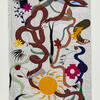
Yone Makino (Lima, 1997) is a visual artist who graduated from the Painting program at the National School of Fine Arts (ENSABAP). She has experience in museographic assistance and collaboration on curatorial projects. Her artistic practice is grounded in research and the interpretation of memory, identity, the passage of time, and the Japanese diaspora.
In her painting, she explores materiality through intuition and gesture to create fictional narratives about the everyday, the nostalgia of remembering, and reflections on identity. She has presented two solo exhibitions: Pensamientos de Caracol (Vesper Tzu, 2026) and No dejes que la nostalgia te consuma (Espacio Encuentro, 2025). She has also participated in two duo projects and numerous group exhibitions in Lima, Arequipa, Miami, and France. She was part of the VII Nikkei Young Art Salon at the Peruvian-Japanese Cultural Center (2023). She is currently based in Lima and represented by Vesper Tzu Gallery.
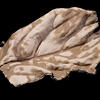
Elizabeth Vásquez Arbulú (Lima, 1990) develops an interdisciplinary artistic practice based on research into territory, culture, and their social and environmental transformations. Her work brings together media such as video, ceramics, sculpture, and site-specific installation, exploring connections between memory, landscape, and systems of knowledge.
Using found objects and archives, she constructs narratives that engage with archaeology, geography, and architecture, activating new readings of identity and collective memory. Her research draws from cultural contexts in Peru—especially Amazonian territories and pre-Columbian traditions—intersecting with contemporary urban dynamics. She has participated in international exhibitions and festivals such as Videobrasil (São Paulo), Matadero Madrid, Conde Duque, CAN Centre d’Art Neuchâtel, and Matucana 100, as well as projects in Peru, Chile, and the United States, including grants from Peru’s Ministry of Culture.
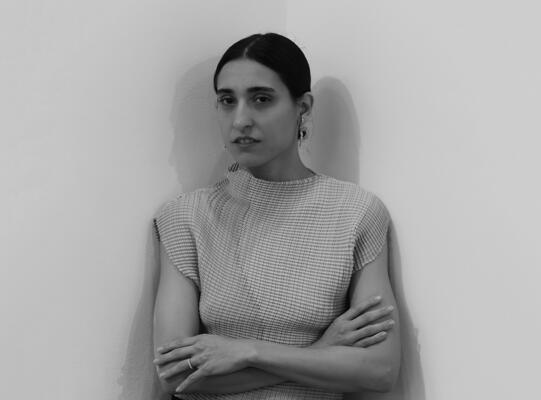
Irene Gelfman
Graduate and teacher of Middle and Higher Education in Arts (FFyL - UBA); she attended the # 11 Artists Program at UTDT (Critic and Curator). She is the winner of the first prize New Curators of the AMALITA Collection and the Argentine Association of Art Critics. She works in curation, management, and art criticism. She is the founder and director of Minerva Universos Visuales, an art studio focused on the dissemination of Art History content for diverse audiences, giving a clinic for artists and consulting for cultural projects. She writes for various media, publications and catalogs (Otra Parte, Colección de Artistas, among others). With more than seven years of experience in different areas of cultural management, both public (national and local) and private (foundations and NGOs), she coordinates and produces content. In addition, she put together the programming in areas such as theater, visuals, and music for different festivals, fairs, and international events in which Argentina was invited as a guest country. She developed and coordinated an aid program to promote Argentine artists abroad (APEX-Ministerio de Cultura Nación) and was a strategic advisor for the Barrios Creativos program.
__________________
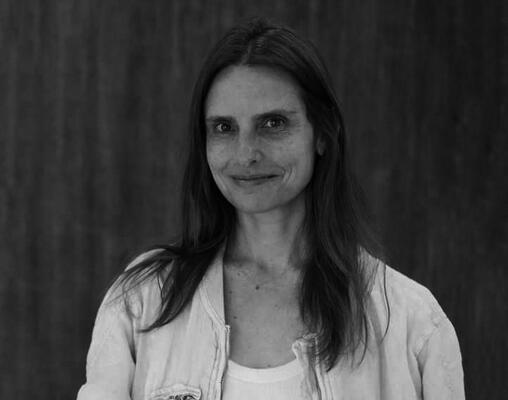
Florencia Portocarrero (Lima, 1981)
Contemporary art curator and researcher trained at the de Appel Curatorial Programme (Amsterdam) and Goldsmiths University of London (London). She was curator of the public program at Proyecto AMIL (2015–2019) and advisor to the Acquisitions Committee of the Museo de Arte de Lima – MALI (2018–2020), and currently teaches in the Master’s Program in Art History and Curatorship at the Pontificia Universidad Católica del Perú (PUCP), where she is also pursuing a PhD in History focused on the work of Nora de Izcue. She is preparing retrospectives of Raquel Jodorowsky at the ICPNA and Sandra Gamarra at MALI, and is co-editor of Unmaking to Make: Art as Decolonizing Practice in Latin America, Future, Past and Present, to be published by UCL Press (Modern Americas series) in April 2026.