
A project by Fundación Pinta for the positioning and promotion of Latin American art.
“Repeating and mastering the form, making spheres of clay, is like raising a prayer with no beginning or end in time. When I look, I hear distant music.”
(Carlos Runcie Tanaka, A Zen Parable and Ten Short Stories, 2007)
Fundación Pinta, the Henrique Faría Gallery, and the Estate of Carlos Runcie Tanaka present the Special Project dedicated to Carlos Runcie Tanaka (Lima, 1958–2025), an artist whose explorations in ceramics—engaging with pre-Hispanic traditions and the language of installation—stand as a fundamental reference in the history of Peruvian and Latin American art.
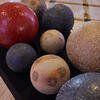
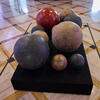
This project brings together a series of works that attest to the persistence of craft and the artist’s ongoing pursuit of mastering the form of the clay sphere. This group of works was produced between 2001 and 2007 and presented in the exhibitions The Same Prayer (Galería Wu Ediciones, 2001), Fourteen / No More, Installation (Galería Enlace Arte Contemporáneo, 2006), and A Zen Parable and Ten Small Stories (Galería Ryoichi Jinnai, 2007).
Between the 1980s and 1990s, Carlos Runcie Tanaka explored in his artistic practice the relationships between sculpture and craftsmanship. He composed his works as installations that integrate diverse references—such as music, performance, and ritual—thus expanding the possible definitions of ceramics as a medium.
His work has been understood as emerging from the convergence of his heritage and artistic training, shaped by the encounter between Japanese tradition, Western perspectives, and the Peruvian territory. From this confluence, and within the context of a concealed Peruvian society, he proposed spaces for dialogue on identity, inclusion, and historical memory.
Through the question of which landscapes in Peru his ceramics might belong to, he created pieces that broaden the understanding of the desert as a space for meditation on identity. In his works, clay evokes rivers, stones, the sea, and crabs in a cyclical experience of coexistence between matter and other vital elements.
His legacy constitutes a profound rethinking of the definitions of the work of art, as well as a sustained and committed artistic practice that gives form not only to objects but also to their own histories. Carlos conceived of what is broken not as material to be discarded, but as a point of encounter with Peruvian reality—rooted in a persistent hope in enduring creation and in the tenacious possibility of reconstruction.

-
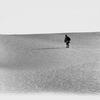
Carlos Runcie Tanaka (Lima, 1958–2025) Sin título (Intervención en el desierto Km. 40 carretera Panamericana Sur) Fotografía: Javier Silva Meinel
-
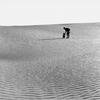
Carlos Runcie Tanaka (Lima, 1958–2025) Sin título (Intervención en el desierto Km. 40 carretera Panamericana Sur) Fotografía: Javier Silva Meinel
-
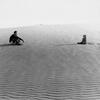
Carlos Runcie Tanaka (Lima, 1958–2025) Sin título (Intervención en el desierto Km. 40 carretera Panamericana Sur) Fotografía: Javier Silva Meinel
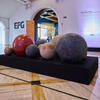

Special Project and Video Project exhibition design by Habitáculo.