

Curated by Irene Gelfman
This edition of the Video Project brings together seven works by three Latin American artists who, through video art, examine the roles and stereotypes constructed by the apparatus of mass media, popular culture, and systems of power and inequality. They reveal how the place and role assigned to women, immigrants, and the idea of Peruvian identity are far from neutral.
On the one hand, Abigail Reyes, from El Salvador, draws from everyday language to reveal its political charge. In Sí Señor (2015–2016), the artist compiled hours of Latin American soap operas in which characters repeat the same phrase over and over again in an obedient, coquettish, and most often submissive manner, until it becomes empty noise. In To Be Secretary (2015), she operates in a similar way: the language of labor becomes a mirror of the structural machismo that the #MeToo movement began to name.
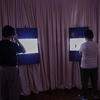
Elena Tejada-Herrera, a Peruvian artist, has spent decades interrogating the spaces that the Latin American body can—or cannot—occupy. Her works challenge notions of political correctness, exploring civil disobedience in a festive way and opening space for alternative forms of existence and relation. In Nouveau Bourgeois Latin American Immigrant Who Learned Shopping and Has Good Taste (2005), she appears in shopping malls and galleries in Virginia and New York wearing stereotypically bourgeois clothing and holding a sign that announces her condition as an immigrant: the contrast is ironic, self-aware, and generates discomfort. In Gallery Land Security (2007), she conducts random security checks at an opening, replicating the experience she herself faces as an immigrant every time she crosses an airport. In both works, the audience ceases to be a spectator and becomes part of the situation.
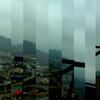
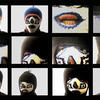
Angie Bonino, a Peruvian artist, works through the body, the city, and the collective imagination of Peru. Her three pieces take seemingly familiar images and destabilize them. In Yo quiero tener un millón de amigos (2007), she merges the icon of the black ski mask—inscribed in collective memory as an image of terror—with its use in traditional Andean dances, creating a vulnerable figure that dismantles fear through humor and sarcasm. In VISION Turistic–a (2014), a guided visit to Cerro San Cristóbal becomes a pretext for a reading of Lima: audio and video clips overlap in layers, as a metaphor for the socioeconomic and historical stratification accumulated in the city. In Evanescer (2010), a woman moves through a space suspended between the real and the subconscious, where desire and imagination emerge as forms of resistance against the limits imposed on femininity.
The three artists share a common strategy: humor and displacement as ways of dismantling what is established. They make evident how feminism operates by shifting things out of place, altering narratives that appear natural, and revealing that what is taken for granted is always a construction. Video, ephemeral and direct, becomes the ideal medium for this gesture: to interrupt, for a moment, the image that culture reproduces without questioning.

Special Project and Video Project exhibition design by Habitáculo.









Irene Gelfman
Graduate and teacher of Middle and Higher Education in Arts (FFyL - UBA); she attended the # 11 Artists Program at UTDT (Critic and Curator). She is the winner of the first prize New Curators of the AMALITA Collection and the Argentine Association of Art Critics. She works in curation, management, and art criticism. She is the founder and director of Minerva Universos Visuales, an art studio focused on the dissemination of Art History content for diverse audiences, giving a clinic for artists and consulting for cultural projects. She writes for various media, publications and catalogs (Otra Parte, Colección de Artistas, among others). With more than seven years of experience in different areas of cultural management, both public (national and local) and private (foundations and NGOs), she coordinates and produces content. In addition, she put together the programming in areas such as theater, visuals, and music for different festivals, fairs, and international events in which Argentina was invited as a guest country. She developed and coordinated an aid program to promote Argentine artists abroad (APEX-Ministerio de Cultura Nación) and was a strategic advisor for the Barrios Creativos program.