

Ana Teresa Barboza: Threaded Stories
Curator Irene Gelfman
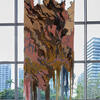
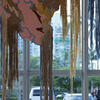
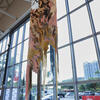
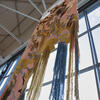
Ana Teresa Barboza’s work (Lima, 1981) invites viewers to touch it and discover its different textures: cotton threads, wool, stones, reeds. Her colors, materials, and forms evoke ancient Peruvian textiles, which narrate the close relationship between local communities and their natural environment.
This work is one of those included in the exhibition Weaving the Stones, her first solo show in Argentina. In her practice, the observation of the landscape and an interest in nature and its incidents are fundamental, but so is the respect for the social networks that relate to her textile work and to the community ties embedded in the materials used for her pieces. Her weavings and embroideries reflect the familial and cultural memories of the communities she works with, whether along Peru’s coastal strip (especially the El Paraíso wetland) or in its Andean region.
Barboza does not seek perfect stitches or postcard-like images. Instead, she gives space to the transformations of the landscape expressed through an unusual use of materials: hydrological maps as the base for her textiles (revealing the water that is no longer there), stones that “breathe” threads, photographs woven together with tapestries. The environment is also present in her particular relationship with the unfinished: the works, like nature, are always in process and subject to change.
In tapestry and embroidery, Ana Teresa Barboza explores ancient practices in order to recover them—on the one hand, in their solitary, private, and reflective dimension; and on the other, as collective and community-based practices rooted in a way of inhabiting the territory and its traditions.


Ana Teresa Barboza
Lima, Perú — 1981
Ana Teresa Barboza uses weaving and other traditional craft techniques to offer viewers a meditative and powerful reflection on the world around her. Early in her career, her work focused on an awareness of the human body, representing it as a segmented and recomposed structure, intervened through sewing and embroidery to explore its relationship with others.
Later, her gaze shifted toward her surroundings, concentrating on the bonds that connect her to other people. Her work then moved toward a more social dimension, opening up reflections on the transformation of nature and the relationship between humans and the natural world. To this end, she employs embroidery and weaving as a parallel between manual labor and natural processes, creating thread structures similar to those that might be formed by a plant. In some works, she simulates experiments that attempt to recompose nature into a new order, inviting us to look at it anew.
In her current practice, she seeks to learn once again from the labor of artisans in order to reestablish contact with the manual and bodily processes through which heritage, culture, and images have taken shape, revealing the traces left upon them by both the body and nature.
A graduate of the Faculty of Art, she has participated in solo and group exhibitions across South America, North America, and Europe, and has pursued further studies and residencies in Paris, Taipei, Geneva, Lima, and Spain. She was selected to participate in the Paiz Biennial (Guatemala), the Sydney Biennale (Australia), the Cuenca Biennial (Ecuador), and the Helsinki Biennial (Finland), and held a solo exhibition at MALBA — Museo de Arte Latinoamericano de Buenos Aires.