

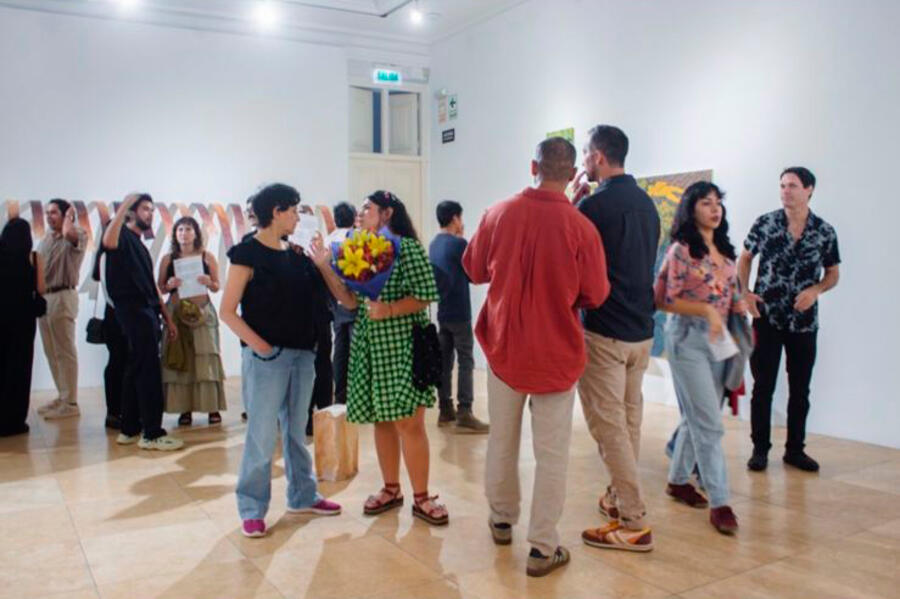
The exhibition “Colorismos” at the Peruvian gallery Proyectoamil brings together Peruvian artists Fabiola Adama, Juan Pablo Bernuy, Juan Carlos Catacora Gutarra, Ximena Ferrer Pizarro, André Daza, Melen, Sergio Pacheco, Walther Sánchez, and Kinshiro Shimura. It reflects on chromatic hierarchy and how it defined racial imaginaries and aesthetic canons.
The message of colors goes beyond mere aesthetics; it influences our emotions, behaviors, and decisions. However, behind this influence lie chromatic hierarchies that have structured racial imaginaries and aesthetic canons.
As children, many of us were familiar with boxes of colored crayons that included a shade called "skin color." Far from being neutral, this designation functioned as an early lesson in representation: a single tone substituted for "the human," while other bodies were defined as deviation or excess. These chromatic hierarchies have long structured both racial imaginaries and aesthetic canons.
In Peru, visual culture has participated in the production and legitimization of social stratification since the 16th century. Color became an index of difference and a mechanism of power, perpetuating the idea that white skin is the standard.
The colonial regimes of the image not only reflected racial classifications but also naturalized them, incorporating color distinctions into religious iconography, portraiture, and value systems. Color became both matter and metaphor: an index of difference and a mechanism of power.
Historically, the use of "flesh color" for the color pink has perpetuated the idea that only white skin is the standard, which is considered a discriminatory bias.
Colorisms examine how these dynamics persist in contemporary visual culture. Through painting, installation, and research-based practices, the participating artists interrogate the moral, political, and symbolic weight attributed to color. Does color still carry an ethical dimension? How do aesthetic traditions continue to legitimize structures of exclusion? And what forms of subjectivity become possible when chromatic hierarchies are destabilized?
_____________
“Colorismos.” Group exhibition.
Proyectoamil Av. Pedro de Osma 409, Barranco. Lima, Perú.
The exhibition will be open until May 9.