
Gaudencia Yupari Quispe
Bio
Gaudencia Aquilina Yupari Quispe (Sarhua, Ayacucho, Perú, 1966) is a Peruvian textile artist, singer, and painter of Tablas de Sarhua, a pictorial tradition that originated in the Andean community of Sarhua, Ayacucho, in south-central Peru. Tablas de Sarhua are given as housewarming gifts to families in the community.
Made from wooden planks between 2 and 3 meters high, crafted from local native trees, the painted boards are read from bottom to top and tell the family history of those who receive the gift.
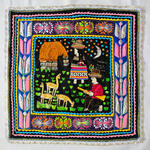
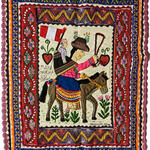
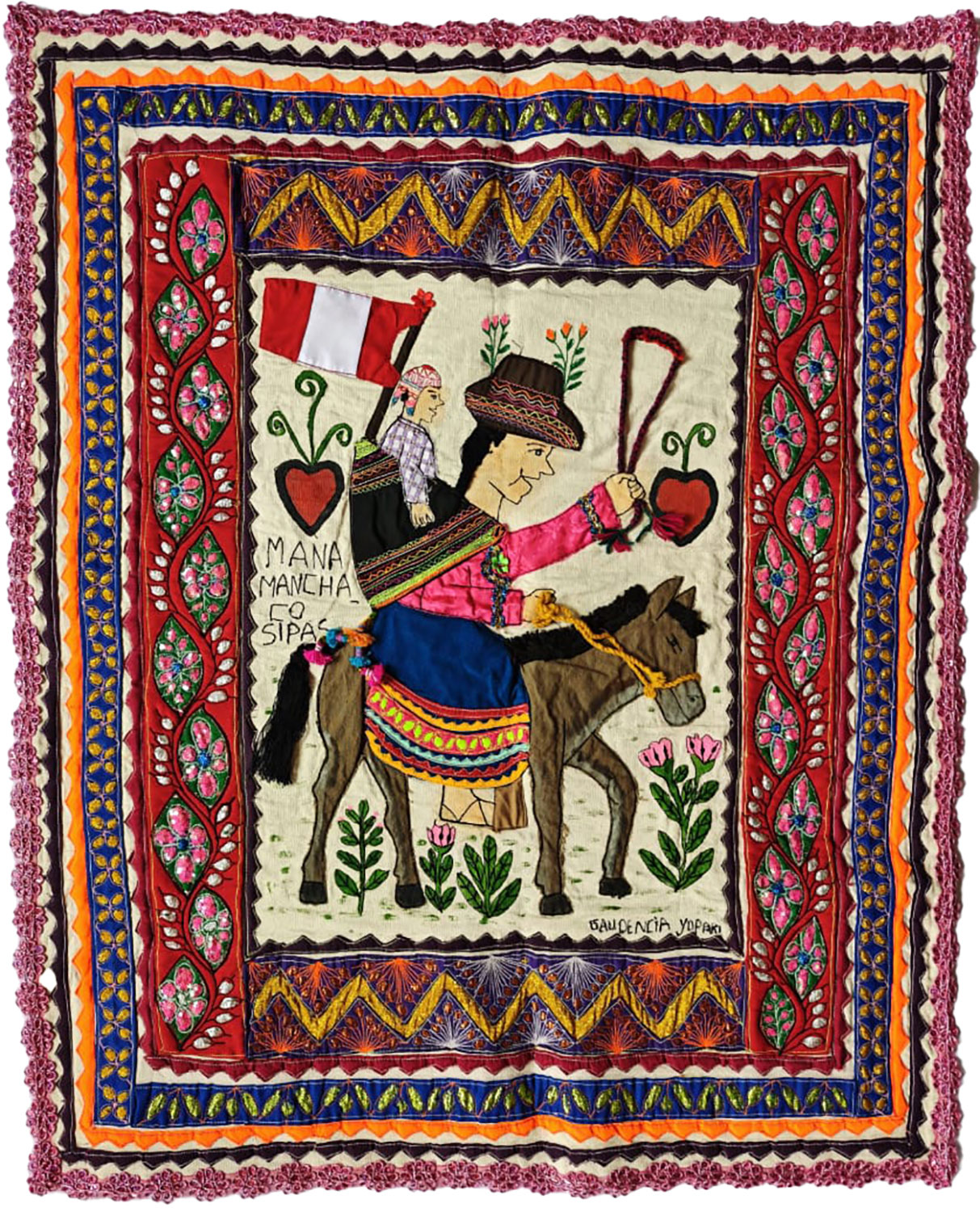
More recently, as an exceptional embroiderer using designs characteristic of her community, she has produced a series of textile panels with autobiographical references and references to her place of origin. Many of them are inspired by the narratives depicted on the aforementioned boards.
Together with her daughter, Violeta Quispe, she founded Taller VIGA. Recently, two of her textiles were incorporated into the collection of the **Museo Nacional Centro de Arte Reina Sofía, Madrid**. She participated in the XV National Painting Competition of the Central Reserve Bank of Peru, Lima, February–April 2025. She currently resides on the outskirts of Lima.
Statement
Sarhua is an Andean community located in Ayacucho, Peru, known for its pictorial tradition of the Tablas de Sarhua and its textile art, which is an integral part of the community’s clothing and visual identity. Due to the migration of Sarhua men and women to Lima during the 1970s and 1980s, these traditions were also brought along with them.
In the district of Chorrillos, south of Lima, Gaudencia Yupari Quispe (Sarhua, 1965) perfected her embroidered designs on blouses and polleras (traditional skirts), which she made both for herself and for other Sarhua women migrants and their daughters. In this work, she developed the use of complex motifs and vibrant colors, creating figures that represent hills, flowers, and plants from the Andean world, visible in the horizontal bands of the polleras.
In some of her most recent embroideries, she often depicts idyllic scenes of life in Sarhua, while in other pieces she evokes episodes from her youth and her early motherhood.

2.5 x 4m / 98.4 x 157 in