
By Paco Barragán
Today’s art fairs have become far more than cultural and commercial events; they operate as platforms of visibility, machines of global branding and instruments of geopolitical power. The rivalry between the mega fairs exemplifies the newest phase of art’s globalization, but this system—in which fairs shape where capital circulates, where legitimacy is produced and which cities become cultural nodes—did not emerge naturally. It emerged from a broader transformation inseparable from the rise of neoliberalism since the 1980s under Ronald Reagan and Margaret Thatcher, reaching its symbolic apex with the fall of the Berlin Wall in 1989. The globalization of capital, the liberalization of markets and the rapid expansion of cross-border financial flows reshaped not only economies but also the cultural sphere, accelerating the transnationalization of the art market. The art fair became the perfect platform for this new regime: a flexible, mobile, instantly deployable structure capable of producing visibility, attracting investment and activating cities as temporary cultural markets.
-
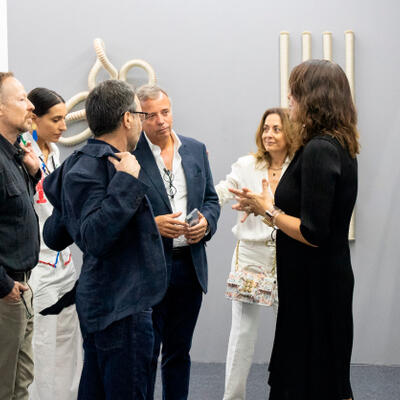
Isabel Aninat Gallery, Santiago de Chile, at Pinta Lima, 2024.
-
Work by Polish artist Rafal Zajko at Coulisse Gallery in the Focus section, Frieze London, 2025. Linda Nylind
-
Art Basel Hong Kong, 2025. Courtesy Art Basel
-
CONTEXT Art Miami, 2025. Courtesy Ken Hayden / CONTEXT Art Miami
-
ARCOmadrid, 2026. Photo: Paco Barragán for Observer
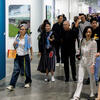
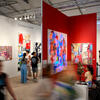
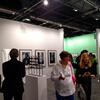
The experiential art fair was born in Madrid
When we look back at the evolution of the Global Art Fair, or GAF, in the 1990s, the real rupture did not occur in Basel or in Cologne, where the first European fairs emerged, but in Madrid. Under the direction of Rosina Gómez-Baeza, ARCOmadrid introduced a format that, at the time, seemed anomalous: part art fair, part biennial, part urban cultural festival.
By the early 1990s, Art Basel was entering what Lukas Gloor, former director of the Swiss Emil Bührle Foundation and one of the most knowledgeable analysts of Basel’s institutional history, has described as a period of structural fatigue: declining revenues, an outdated selection system, inadequate exhibition formats and growing competition from new fairs in Paris, Chicago and, increasingly, Madrid. FIAC, Art Chicago and ARCOmadrid began to challenge Basel’s long-standing dominance by offering fresher formats, stronger curatorial voices and a more dynamic engagement with artists and institutions.
In 1989, Ernst Beyeler and Trudl Bruckner—two of the founding gallerists who had shaped the early Basel ethos—stepped back from the selection committee, marking not only a generational transition but the recognition that Basel could no longer rely solely on modernist authority in a rapidly globalizing art market. When Lorenzo Rudolf took over in 1991, he inherited a fair that urgently needed reinvention—while in Madrid, a new model was already taking shape. But why was Madrid able to invent a new format when Paris, Chicago or New York could not?
Spain, emerging in the early 1980s from four decades of dictatorship, was culturally starved and eager to reconnect with contemporary art. When Rosina Gómez-Baeza took over ARCOmadrid in 1986, she inherited a publicly funded fair supported by the City of Madrid, the Regional Government and the Chamber of Commerce, and championed unreservedly by the national press and the political establishment. At a time when Spain had almost no contemporary art museums—the Museo Reina Sofía would not open until 1992—ARCOmadrid became the country’s principal gateway to international art.
Within a few years, it was attracting more than 100,000 visitors, driven by an unusually young audience whose enthusiasm transformed the fair into a cultural event of national significance. Spain’s determination to reinsert itself into the global cultural circuit allowed Gómez-Baeza to build what other fairs could not: high-level theoretical panels that brought figures such as Glenn D. Lowry, Hou Hanru, Barry Schwabsky, Ute Meta Bauer, Okwui Enwezor and Alanna Heiss to Madrid; alongside curated sections and guest-country programs led by documenta and biennial curators such as Jan Hoet, Nicolas Bourriaud, Chus Martínez and Dan Cameron. All of this was accompanied by parallel exhibitions across the city’s institutions and an ecosystem of openings, receptions, parties and after-hours that turned the fair into a week-long urban experience.
Yet ARCOmadrid could only operate at this scale because it devoted around one million euros every year to promotion, invited guests and international collectors—a figure unmatched by any other fair, and something neither Art Basel nor Frieze has ever had at its disposal. In a country with no established market, no gallery system of scale and hardly any museums of contemporary art, ARCOmadrid ended up catalyzing the very infrastructure it lacked—precisely because nothing comparable existed.
It endowed the emerging Global Art Fair with what I have termed the curator–open–space model. At ARCOmadrid, curators were not an accessory but a structural presence: curated sections, project rooms and guest-country pavilions broke with the classical dealer-booth-and-alley grid and replaced it with open formats that operated more like biennial zones than commercial corridors. The fair also began to expand physically beyond its own architecture—into museums, public institutions and the city itself—anticipating later developments such as Art Basel Unlimited or Frieze Projects.
Meanwhile, in Switzerland, Lorenzo Rudolf—supported closely by influential dealers such as Pierre Huber, Gianfranco Verna and Felix Buchmann—was radically restructuring Art Basel. Together they replaced the traditional dealer-driven logic with a project-based selection system that aligned with the new neoliberal ethos of the 1990s; what mattered was no longer a gallery’s pedigree but the strength and ambition of its proposal.
At the same time, Sam Keller, then the fair’s young and hyperactive director of communications, traveled to Spain and spent a full week embedded with the ARCOmadrid team. He observed not only the curated sections and the guest-country programs but also the entire ecosystem of theoretical panels, museum openings, receptions, parties and the unmistakable Madrid rhythm that culminated every night—without fail—with the art crowd ending up at the legendary after-hours Bar Cock.
The contrast with Basel’s earlier experiments was stark. ARCOmadrid had made curatorial input the core of its identity. It introduced ARCO Videoarte as early as 1987, while Art Basel’s Bankverein Video Kunstpreis would only follow in 1994; it launched Cutting Edge in 1996, with Art Basel’s Statements section appearing later that same year; it created the Project Rooms in 1998, two years before Unlimited in 2000; and from 1994 onwards its Guest Country programs installed national pavilions inside the fair as a central device.
ARCOmadrid, in other words, had already embraced the curator as the central agent of the fair, creating what would become the first fully articulated curated art fair. Its yearly Guest Country structure reproduced with unexpected clarity the logic of the Venice Biennale. It was this conceptual leap—turning the fair into a curatorial platform rather than a mere corridor of booths—that Keller saw unfolding in Madrid, and that Basel was only just beginning to realize it needed to emulate.
This transformation was evident to observers at the time. The Madrid model produced a cultural intensity that exceeded anything seen in Basel, Chicago or Paris. As cultural journalist Miguel Mora wrote in El País in 1997, the exhaustion visible on visitors’ faces came from an overloaded program of performances, parties, museums, art fairs, conferences and after-hours—before beginning again the next day.
Few descriptions capture more vividly how ARCOmadrid had already evolved into a full-scale urban event—a precursor to the experiential model that would later become standard across the Global Art Fair ecosystem.
The GAF origin story, the Miami turn and the London response
If ARCOmadrid invented the experiential art fair, it was in Miami in 2002—when Art Basel exported its brand to the United States—that the model finally became global.
What emerged there was not an American imitation of Basel, but the first fully realized prototype of the Global Art Fair: the ARCOmadrid model pushed to its most festive and immersive extreme, amplified by a city with beaches, warm weather and a thriving club scene.
What took shape in Miami was the operational birth of the Global Art Fair. The fair ceased to be a self-contained commercial hall and re-emerged as a city-wide machine: satellite fairs, the public opening of major private collections, and the creation or consolidation of new museums collectively rewired Miami Beach into a temporary cultural metropolis.
Art Basel Miami Beach did not simply expand the fair; it mutated it. It created the first true fair week, fused curatorial content with lifestyle spectacle and elevated the role of the fair director beyond traditional managerial expectations.
Within a year of Art Basel’s breakthrough in the United States, Frieze London emerged not as a rupture from this new experiential logic but as its most metropolitan and editorially refined iteration. Founded by art publishers Amanda Sharp and Matthew Slotover, the fair arrived with a degree of critical authority and cultural legitimacy unprecedented for a new art fair.
Under the curatorial direction of Neville Wakefield, Frieze Projects embedded a strong curatorial identity at the core of the event. The fair’s proximity to London’s fashion industry, publishing houses and creative-class networks gave it a tone of effortless sophistication: a mix of institutional credibility, cultural cool and metropolitan glamour.
Art Basel thus arrived at the experiential logic of the new Global Art Fair through crisis, reinvention and progressive adaptation, whereas Frieze was born directly into that paradigm.
The four fronts of the art fair war
The rivalry between Art Basel and Frieze does not unfold chronologically but territorially, across a set of differentiated battlefields where each region imposes its own conditions of victory.
The fair war is a multi-front conflict in which saturation, acceleration, symbolism and geopolitics determine who can dominate visibility, institutional legitimacy and cultural capital.
In the United States, Art Basel holds the strategic advantage, particularly through Art Basel Miami Beach, which remains the only fair capable of reprogramming a city through a dense ecosystem of satellite events, private collections and institutional activity.
In Asia, Art Basel consolidated its position through the acquisition of Art HK and its transformation into Art Basel Hong Kong, establishing the city as the region’s dominant art-market hub.
Frieze Seoul, launched in 2022, has significantly elevated the international visibility of Seoul Art Week but operates within a different framework: it amplifies an existing ecosystem rather than redefining the continent’s flows of capital and legitimacy.
In Europe, the strategic field revolves around historical authority. Art Basel Paris, launched in 2022, reconnects the fair with the symbolic capital of modern art history, reinforcing Paris’s institutional density and cultural prestige.
In the Gulf, meanwhile, art fairs function as instruments of cultural diplomacy and soft power, with state-aligned initiatives seeking to project geopolitical visibility through cultural infrastructure.
Latin America, Africa, Australia, Canada and the myth of global art
The notion of “global art” often dissolves under empirical scrutiny. Despite the rhetoric of internationalization, the structure of the art-fair system remains highly concentrated in a small group of Western countries.
Studies of Art Basel participation show that the majority of galleries still come from a handful of nations—Germany, the United States, the United Kingdom, France, Switzerland and Italy—while the rest of the world remains marginally represented.
Latin America hosts vibrant artistic scenes, yet none of its fairs has achieved the financial or infrastructural density required to anchor a Global Art Fair-level event. Platforms such as arteBA, ZONAMACO, ARTBO and SP-Arte have strengthened regional circulation but have not consolidated global visibility.
Africa faces an even more pronounced structural gap. While the continent produces strong artistic work, it lacks the institutional density and market concentration required to establish a central node within the global art-fair system.
Australia and Canada illustrate similar dynamics: culturally rich ecosystems with respected institutions but without the commercial scale necessary to generate a globally dominant fair platform.
Why only some fairs become global nodes
A final distinction emerges between global fairs and regional fairs. A very small number of events attract collectors and institutions from across the world, while most fairs operate primarily within regional ecosystems.
This divide explains why some fairs reshape the global map while others remain structurally local. Origin alone does not determine destiny; the decisive factor is the ability to scale, consolidate networks and occupy strategic cultural and financial nodes.
Art Basel has operated as a geopolitical architect, selecting and consolidating the most decisive cultural centers. Frieze has expanded largely by embedding itself in places where the ecosystem was already formed.
The majority of art fairs worldwide remain locked in regional circuits. They do not reorganize flows of capital or legitimacy, and they do not alter the global map.
As of today, the truth about the global art-fair wars is simple: Art Basel changes cities; Frieze joins them. The rest observe from the regional margins.
Originally published in Observer.
https://observer.com/2026/03/inside-the-global-art-fair-wars-frieze-art-basel/