
Kate Hepburn
Bio
Kate Hepburn (London, 1947–2024)
After completing her studies at the Central School of Art & Design (now Central Saint Martins), she went on to earn an MA from the Royal College of Art in London in 1972. For more than four decades, her work has been a benchmark in British visual culture, particularly in publishing, graphic arts, and pop-rock.
In 1974, she was commissioned by Pink Floyd's Nick Mason to paint the band's drum kit for their legendary tour of Japan, entitled 'Hokusai's The Great Wave'. Throughout the 1970s, she collaborated with the legendary group Monty Python, which introduced her to the publishing industry and mass media. Her time as a graphic designer was strongly influenced by her work at Spare Rib, the UK's first feminist magazine. She also collaborated with other major British publishing houses and magazines of the era, such as the Quarto Literary Newspaper, Vole Ecology, and Vértigo.
Her work has been exhibited at the Kyle Gallery, the Natural History Museum, the Barbican Centre, the Jake Fior Gallery and the Tchoban Museum in Berlin. Recent contributions to the Pink Floyd exhibition at the Victoria & Albert Museum and the Rolling Stones exhibition at the Saatchi Gallery in London motivated her to rediscover her personal work from the 1960s and 1970s.
Alongside her artistic and graphic work, Hepburn has devoted herself to teaching, working as a lecturer at the Central School of Art & Design, Central Saint Martins, and Ravensbourne College of Design.
Her most recent exhibition took place in 2022 at Palazzo Morosina in Venice, a venue dedicated to the production and promotion of printmaking.
Statement
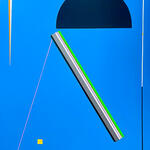
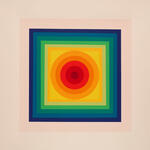
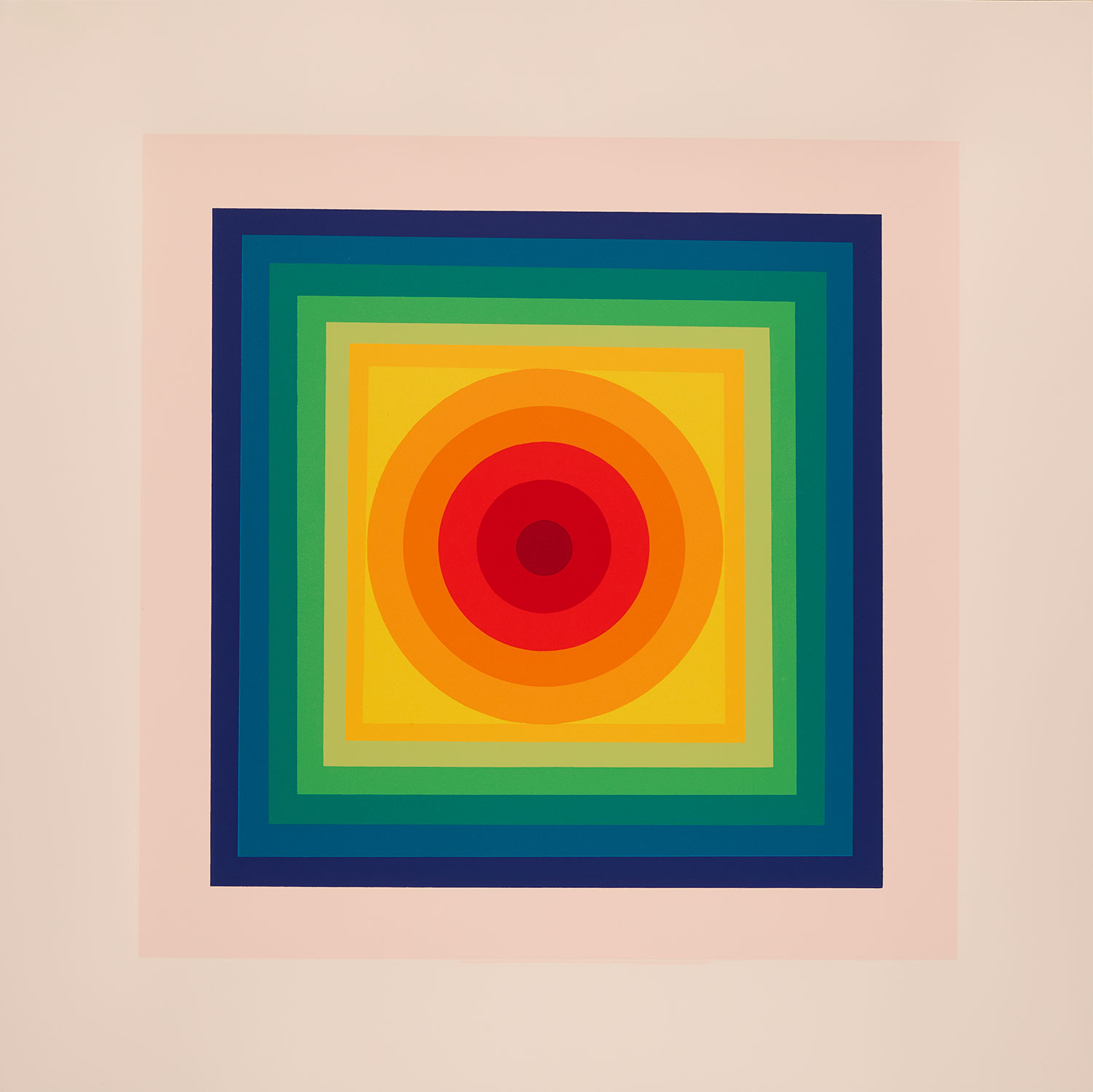
Kate Hepburn originally conceived the works in the “Curves, Circles & Bends” series between 1966 and 1967 at the Central School of Art in London. This was a period of great creativity, experimentation and the fusion of art, music and fashion.
Over 50 years later, Hepburn embarked on a project to reproduce the original hand-printed works using the bright, oily inks of the era on 100% cotton Somerset archival paper. Screen printing proved to be the ideal technique as it offered a direct and accessible way to experiment with colour and form. The 'Bends' series features layers of geometric shapes, while 'Circles' evokes the iconic stripes and spheres of 1960s British fashion designer Mary Quant.
Drawing inspiration from her early series developed in the 1960s, this series is set against the backdrop of an era of artistic and technological explosion. Geometric shapes and a profusion of colour took over art galleries, fashion catwalks and the visuals of pop and rock bands – in short, the entire visual culture of an era that left its mark on art and design.
Hepburn’s work clearly embodies the dynamism of the 1960s and 1970s on a grand scale. It was a forward-thinking era and a way of life through creative expression.

2.5 x 4m / 98.4 x 157 in