

Curated by Gredna Landolt
The Amazonía’s art section exhibits recognized artists from native Amazonian tribes.
Lo que los ojos no ven (What eyes can’t see)
Gredna Landolt
Amazonian art is one of the most important contemporary Peruvian art phenomena. Artists from native communities have empowered themselves with Western art media and techniques to express their own imagery and cultures.
“What eyes can’t see” brings together renowned artists from native Amazonian tribes: Chonon Bensho, Lastenia Canayo, David Díaz, Dimas Paredes, Gerardo Petsaín, Brus Rubio Churay, Roldán Pinedo (Shoyan Shëca), Wilmer Silvano, Frank Soria, Elena Valera (Bahuan Jisbë), Celia Vásquez and her daughter Diana Ruiz, Santiago and Rember Yahuarcani. Also, Awajún potters will participate such as Julia Apikai, Luzmila and Virginia Kajekui, Ofemia Mujat and Margarita Tinchu; and Shipibo ceramists like Florencia Flores Flores, Gloria Amasifuén and Delia Rengifo Cauper, among others included in the Martín Ccorisapra collection.
The title of this exhibition refers to a common theme: the multiverse inhabited by guardian spirits or "mothers" that protect natural species from being depredated or harmed, as well as other spirits that dwell in different spheres or dimensions that are considered part of the world. They cannot be seen with the naked eye, but they manifest themselves in different ways: either spontaneously, under different appearances, or through the ingestion of ayahuasca or other plants considered sacred, which are used to heal people and "expand the vision". These beings relate to humans, mate with them or intervene in their lives; they grant or withhold permission to hunt, fish or cut down trees. They play a key role in the balance of species.
The artists belong to various native Amazonian tribes, are from different generations, and use different media. Santiago Yahuarcani, notable artist of the Aimeni people represented by the Crisis gallery, exhibits "Shaman's flight suit", a painting done with natural dyes over vegetable bark or llanchama. It shows a shaman dressed with tiger, eagle, centipede, ray fish and snake skin –animals of “strong blood”– to protect himself and be able to make spiritual fights or heal the sick.
Dimas Paredes’ work –a disciple of Pablo Amaringo (founder of the visionary Usko Ayar school of Puallpa)– is entitled “The protection of the World”. There, the purahua –beings that inhabit the cochas or lagoons, whose ferocity can destroy the world– are mixed with characters from the artist’s own mythology, such as the Goddess of the Universe, who has the power to save it.
One of the works by Roldán Pinedo (Shoyan Shëca) and Elena Valera (Bahuan Jisbë) –renowned Shipibo painters who alternate their work between the use of colored earth and natural dyes with acrylics– is about the beings that rule in the water space. Meanwhile, Lastenia Canayo represents in her paintings –as well as in figures carved by her son Wilmer Silvano– the guardian spirits of the plants. Awajún artist Gerardo Petsaín participates with delicate drawings, some in collaboration with Leslie Searles, made in Santa María de Nieva. Talented artists such as Celia Vasquez and her daughter Diana Ruiz, Chonon Bensho and Brus Rubio, with very powerful and original work, are now represented by the Shipibo-Conibo Center in New York. The work of Rember Yahuarcani, with a singular style, is being exhibited around the world, while young artists such as Frank Soria and photographer David Diaz, are quickly beginning to stand out in the art world.
Awajún pottery, with a very contemporary aesthetic, is part of this exhibition thanks to Irma Tuesta, who has been working for many years with the women of the communities of the Comaina and Cenepa rivers in Amazonas, where she comes from. The ceramists turn to Nunkui –"mother" of the earth and the fruits of the farm– so that the pots are beautiful and well-done. Martín Ccorisapra's Shipibo pottery collection is the most important of its kind. On display are joni chomos (anthropomorphic pitchers) and mahuetás (jars) from the communities of the Pisqui and Caco rivers. Their beautiful kené or designs have the particularity of being unique, and there is still no certainty about their enigmatic origin. For some of the compositions, they get inspiration in the mythical skin of Ronin, the primordial boa; for others, in the luminous vibrations generated by the intake of ayahuasca or in the constellations or "paths of the sky".
"What eyes can’t see" is also an invitation to unveil all the richness that Amazonian indigenous art contains and that is not perceived with the naked eye.
We are facing art that is alive, that is increasingly gaining a prominent presence in contemporary art, and will continue to surprise us.
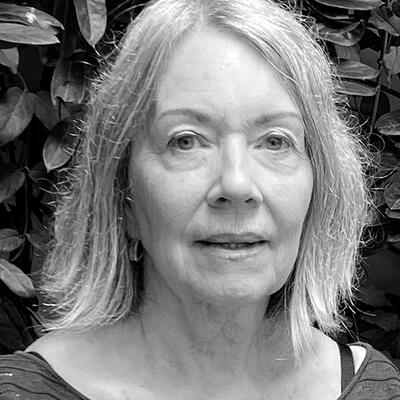
Gredna Landolt Pardo
Graphic artist, she works as curator of the Inca Garcilaso Cultural Center of the Ministry of Foreign Affairs. She has been a consultant for the Bilingual Teacher Training Program of the Peruvian Amazon–Formabiap. Among her main curatorships on the subject are: Amazonías, with Sharon Lerner (Matadero Madrid, 2019); Plantas maestras, visiones del bosque, paintings by Dimas Paredes (CC Inca Garcilaso, 2019); Awajún y Wampís: Construir, habitar, imaginar el territorio. Drawings by Gerardo Petsaín (CC Inca Garcilaso, 2015); La Amazonía de Ch. Kroehle. Photos and postcards from the late 19th and early 20th centuries (CC Inca Garcilaso, 2010); El Hombre Lluvia, El Cielo y la Tierra, with Luisa E. Belaunde (Museo de Arte del Centro Cultural San Marcos, 2009); Ani Shëati, La Gran Fiesta Shipibo, with Martín Ccorisapra (CC Inca Garcilaso, 2008); Es nuestra costumbre, two-person by Elena Valera and Roldán Pinedo -who integrated Amazonía al descubierto, curated by Pablo Macera- (Museo de Arte del CC San Marcos, 2005); Serpiente de agua, la vida indígena en la Amazonía, with A. Surrallés (Desamparados Cultural Station, 2003); El ojo verde. Cosmovisiones amazónicas, with Pablo Macera and co-organized with Formabiap (Fundación Telefónica, 2000). Landolt Pardo is a member of the Academic Committee of the Lima Art Museum and has been an invited curator at the VI and XXVI Auctions of MALI and PArC 2019. She has received the Orden Gran Cruz for Merit from the Diplomatic Service of Peru J. G. Paz Soldán 2021. She is editor of "El ojo verde" and "Serpiente de agua", "Tejidos enigmáticos de la Amazonía peruana" and "El ojo que cuenta. Mitos y costumbres de la Amazonía indígena ilustrados por su gente".