
Andrea Alkalay
Bio
Argentine visual artist and industrial designer (UBA). Her practice operates at the intersection of photography, materiality, and research. Through experimental processes and mixed media, she explores the relationships between territory, memory, and image, focusing on the traces left by historical, urban, and industrial processes on the landscape.
She has participated in programs including Proyecto Imaginario, Art and Bioaesthetics (MUNTREF), Escuela de Artes y Oficios (EAO), the Artistic Practices Workshop with Lorena Fernández, and Liminales Expandidas at Galería Acéfala. In 2026, she was selected by Taiwan’s Ministry of Culture for a residency at Soulangh Cultural Park, where she presented a solo exhibition, and later continued this line of research in Chile, through the SACO Biennial, Post-Industrial Heritage program. Between 2022 and 2024, she developed an extensive research in Saudi Arabia, receiving 3 grants from the Saudi Ministry of Culture and The Kingdom Photography Award. She was also appointed Mentor by the Visual Arts Commission.
Her work has been exhibited in Argentina, Slovenia, Saudi Arabia, South Korea, the United Arab Emirates, India, and Taiwan, and is held in public and private collections. She lives and works in Buenos Aires.
Statement
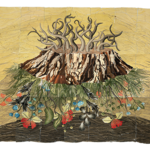
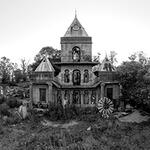
I work with wounded territories, areas of extraction, abandonment, and transformation. I am interested in ruins and remains because they speak in the present about the past, and in the peripheries as fields of truth. Across different geographies, I investigate the relationships between matter, image, and territory, as well as the intersections between the ancestral and the industrial. I question how we inhabit these territories, what cycles they undergo, and what remains hidden. Traditional crafts and ancestral knowledge allow me to approach materials as carriers of information about their places of origin and belonging. I construct landscapes through expanded photography. Through fieldwork, I reconfigure fragments of the environment — images, surfaces, and waste — into object-based constructions and installations.
Landscape operates in my work as a means of accessing these stratified systems. I use artifice not to distance myself from reality, but to make some of its layers visible.
An active archive, a poetic archaeology.
Additional information
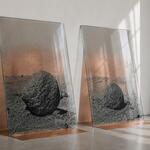
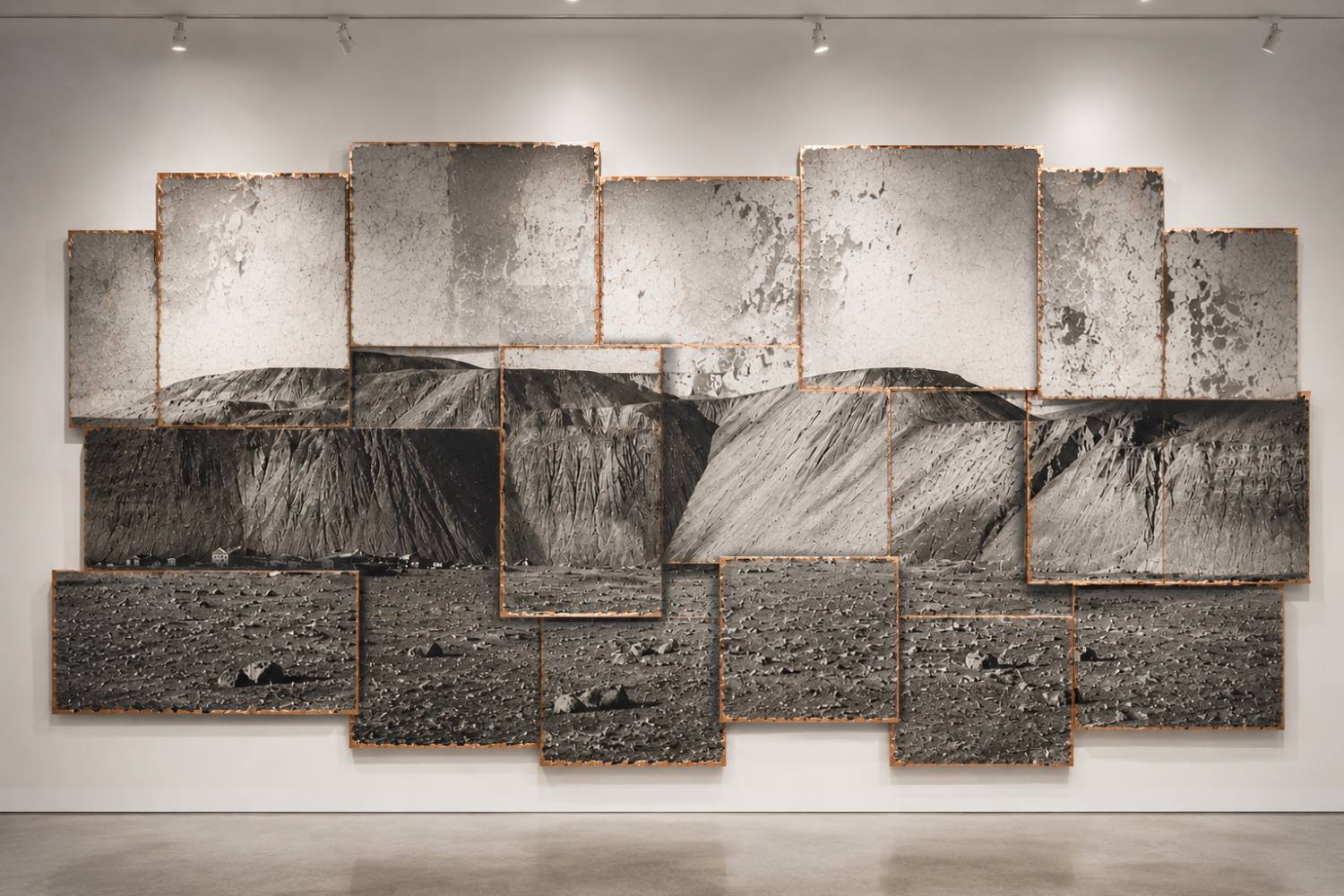
La instalación mural presenta una geología sintética, fragmentada y erosionada, que toma como referencia la condición tectónica del territorio. El cobre aparece de manera irregular y mínima en los bordes, grietas y fracturas de estas placas. Su presencia hace visible la desproporción entre la inmensa escala del territorio transformado y la pequeña cantidad de materia extraída. La imagen queda incorporada a una materia industrial. El paisaje deja de ser entendido como algo fijo para aparecer como un proceso dinámico, en permanente transformación