
Ana de Alvear
Bio
Ana de Alvear uses archetypes giving special focus on self-esteem and it’s development. These archetypes are used in order to facilitate its identification or rejection in the viewer who is doomed to have to overcome their reluctance to get to the fundamental wisdom of their own identity. The Spectator is involved in a dialogue, which transforms their physical and spiritual perception, challenging their archetypal feelings by separating the elements of reality to which they belong, changing its intrinsic meaning. In her film work she appeals to the Spectator as an individual, suggesting the identification with the main character, enabling the viewer to see through the perspective of the eyes of others. This new point of view gives us the chance to discover ourselves, because that 'OTHER' allows us to see ourselves as if through a mirror [Ana de Alvear]. Through visual tales, the viewer is invited to find the limits of himself, having the opportunity to move from his usual environment or comfort zone. The viewer is led to reflect on their own visual prototypes and their archetypes regarding "the child" or "the adult", thus being able to resolve this paradigm individually. Using resources found in classic works or themes, she uses stuffed animals and other types of toys, which symbolically represent child abuse, because if we killed a stuffed animal what we would be killing would be innocence, play, childhood... The plants and insects are also fake, paradoxically making everything appear dead, as if it had never lived, and, insodoing invites the viewer to rethink what they see, instead of settling for the first impression. At the same time, the fascination in the aesthetic sense of simplicity, where microcosms and macrocosms interact within an interchangeable poetic, makes this metamorphosis possible, introducing the audience into a poetic space full of emotions. Adjusting to each space specifically, her work is based mainly on multidisciplinary installations where new experimental materials and media play a fundamental role considering them part of the dialogue. Since 1997 she has collaborated with her sister Maria de Alvear (Composer). Part of her work is therefor related to avant-garde music productions with pioneer works in multidisciplinary concerts where she continues colaborating with composers from all over the world. Pictorial works such as "Once upon a time... and now what" in which the future of nature is questioned has been exhibited in Museums of Natural Sciences and Botanical Gardens where the public of any age could reflect on their responsibility with respect to future generations. Specializing in large-format drawings, her 3 x 7-meter Galaxies have been exhibited on several occasions in various spaces such as the Alcobendas Art Center in Madrid, the Cuenca Cathedral or the San Diego Museum of Art in the US.
Statement
Ana de Alvear (Madrid, 1962) creates hyper-real trompe-l’œil drawings using only colored pencils, pairing virtuoso craft with a conceptual investigation of archetypes, with particular focus on self-esteem and its formation. She deploys archetypal figures and narrative structures to prompt identification or rejection in the spectator, compelling them to overcome reluctance and reach a more fundamental knowledge of their own identity. Through carefully staged visual tales, she separates elements of reality from their habitual contexts, shifts their intrinsic meaning, and engages viewers in a dialogue that transforms both physical and spiritual perception—inviting them to test their limits and step beyond their comfort zone. Her work has been presented across leading institutions including the Museo Nacional Centro de Arte Reina Sofía (MNCARS), The San Diego Museum of Art, Centre Pompidou (Paris), MoCA Shanghai, Hara Museum (Tokyo), MOCA Seoul, CaixaForum (Madrid), Museo Lázaro Galdiano, Real Jardín Botánico, and the Museo Nacional de Ciencias Naturales (Madrid), among others.

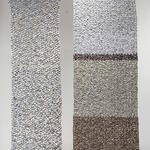
2.5 x 4m / 98.4 x 157 in