

By Violeta Méndez
Tropical hyperstition, decolonial conquest. A twenty-meter hammock hangs at the center of the Panama Pavilion at the 2026 Venice Biennale. Artists Antonio José Guzmán (Panama, 1971) and Iva Jankovic (Yugoslavia, 1979), the artistic duo known as Messengers of the Sun, confront colonial memory and seek to restore the voices of erased and displaced peoples—and to reveal the silenced human cost behind one of modernity's most mythologized engineering feats: the Panama Canal.
In this edition, following Panama's first participation in 2024, the country aligned itself with this year's theme. Curator Koyo Kouoh, who passed away before the Biennale opened, proposed In Minor Keys, an exhibition framework in which subaltern narratives, spirituality, and subtle forms of resistance against dominant power structures would take center stage.
Tropical Hypertition, the Panamanian exhibition curated by Elizabeth González and Mónica E. Kupfer, seeks to set the historical record straight. Since 1903, the United States controlled the Canal Zone, operating as a "country within a country." Panamanians could not move freely through the zone, and the sweeping construction carried out in the name of progress displaced entire communities and flooded historic territories. It also sparked major protests and bloodshed—including the tragic events of January 9, 1964—culminating in the signing of the Torrijos-Carter Treaties in 1977, which enabled Panama to regain full control of the interoceanic waterway in 1999.
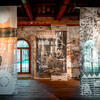
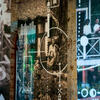
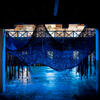
Messengers of the Sun recovers those "lost villages" in Venice through textile cartographies, archival fragments, DNA-based patterns, Caribbean rhythms, water, voices, and the mechanical sounds of extraction. The centerpiece is a twenty-meter hammock suspended at the heart of the space. Dyed with indigo and handwoven, the domestic object evokes the ancestral knowledge of the Americas and the Afro-Caribbean workers who built the Panama Canal. The use of indigo—historically intertwined with colonial economies and forced labor—imbues the textile with political memory.
In Venice—a city built on water, commerce, and empire—the work acquires an inevitable resonance.
Tropical Hypertition is on view through November 22, 2026, at Tesa 42, Arsenale (Fondamenta Casa Nuove, Castello 2738/C, Venice, Italy).