
Gabriela Fernández Madero
Bio
Gabriela M. de Fernández Madero (b. 1960, Buenos Aires, Argentina) is a visual artist whose interdisciplinary practice encompasses photography, printmaking, ceramics, and expanded mixed media. Through these processes, she explores alternative visual languages that engage with image, memory, and materiality.
Since 2004, she has exhibited extensively in museums, galleries, art fairs, salons, and artist residencies in Argentina and internationally. Between 2015 and 2017, she completed artist residencies in Marnay-sur-Seine, France, where she also presented her work. In 2018, she participated in the IMPACT10 International Printmaking Conference in Santander, Spain. She is a member of the Atria collective, together with Laura Cardoner and Carolina Gutiérrez.
Recent exhibitions include Oda, Los sonidos del silencio (2019); Belleza efímera, Palacio Barolo (2023); Memoria y Archivo, BA Photo (2023); Mi Walden, Pinta BA Photo (2024); El jardín nativo, Pinta BA Photo (2025) and La Margarita de Areco (2025); Mi Walden, MACA – Museo de Arte Contemporáneo Argentino, Junín (2025); Home-s, Photopolis Festival, Greece (2026); and Umbrales, H2O, Palacio de las Aguas Corrientes – AySA (2026).
She lives and works in San Antonio de Areco, Argentina.
Statement
The Herbarium of Memory
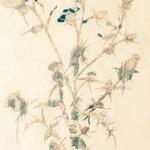
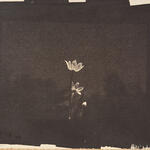
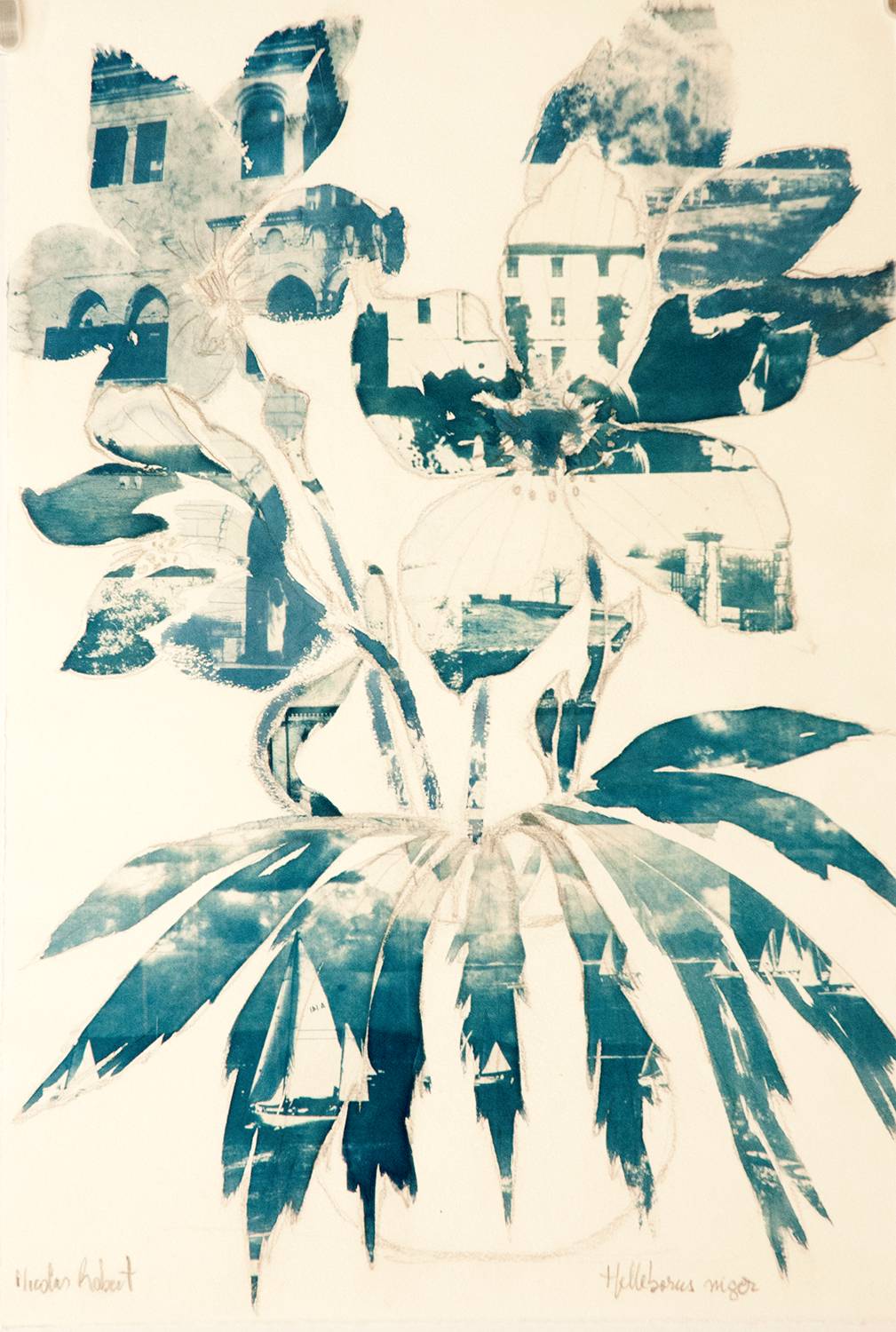
In this series, I explore the relationships between nature, image, and memory through drawing and cyanotype. Flowers that inhabit everyday spaces appear as sensitive territories where emotions, experiences, and memories are deposited; small living archives in which time leaves its marks.
The works emerge from flower drawings created on rice paper or cotton paper, incorporating photographic fragments within their petals. These images appear partially, like apparitions or remnants, evoking the way memory preserves what endures: a trace, a sign, a vestige of the past.
Cyanotype establishes a dialogue with the earliest photographic herbariums and with the tradition of the archive as a form of preservation. However, my interest lies not in the permanence of the image, but in its vulnerability and processes of transformation. Light, the essential element of this technique, preserves while simultaneously revealing the ephemeral nature of what it seeks to fix.
The series revisits the tradition of still life as a meditation on time, absence, and loss. Each work functions as an affective archive where nature and image intertwine in an intermediate territory: a space where memory blossoms, transforms, and slowly fades away.
Additional information
Monotipo, imagen única, técnica mixta, dibujo y cianotípia

2.5 x 4m / 98.4 x 157 in