Patricia Faragone
Bio
Patricia Faragone was born and raised in the city of São Paulo, Brazil. An architect trained at FAU USP, she built a multidisciplinary path through architecture, furniture design, textile dyeing and fashion before making glass the protagonist of her work. She works with glassblowing, casting, fusing and torchwork, having trained in Brazil, the UK, the US and Germany. Moving between collectible design, "art with function" and wearable art, her pieces draw on emotional memories of São Paulo's domestic world in the 1970s and 80s, such as the sweets of her Tutti Frutti series, in dialogue with Brazilian Modernism, the Memphis Group, pop culture and surrealism. Listed in the Homo Faber 2025 Guide, she has shown in exhibitions and fairs including Delirious Garden (Radar, São Paulo, 2026), Sustain the Noise (Verso Gallery, Lisbon, 2025), Collectible with BS Galleria (Brussels, 2026), SP-Arte, Casa Vogue Experience and M.A.D.E. She lives and works between São Paulo, London and Brussels.
Statement
With a multidisciplinary approach, I have devoted myself to architecture and to furniture, textile and fashion design. In search of other materials, I found in glass the protagonist of my work and the joy of expressing a poetic, feminine and inner world. Through glassblowing, casting and other techniques, I handcraft objects between collectible design, "art with function", wearable art or simply art. My pieces translate emotional memories of the domestic environment of the 1970s and 80s and of my childhood in São Paulo, in search of a personal identity. I am inspired by the pioneers of modern design, Brazilian Modernism, the Memphis Group, pop culture and surrealism.
Additional information
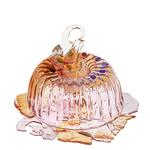
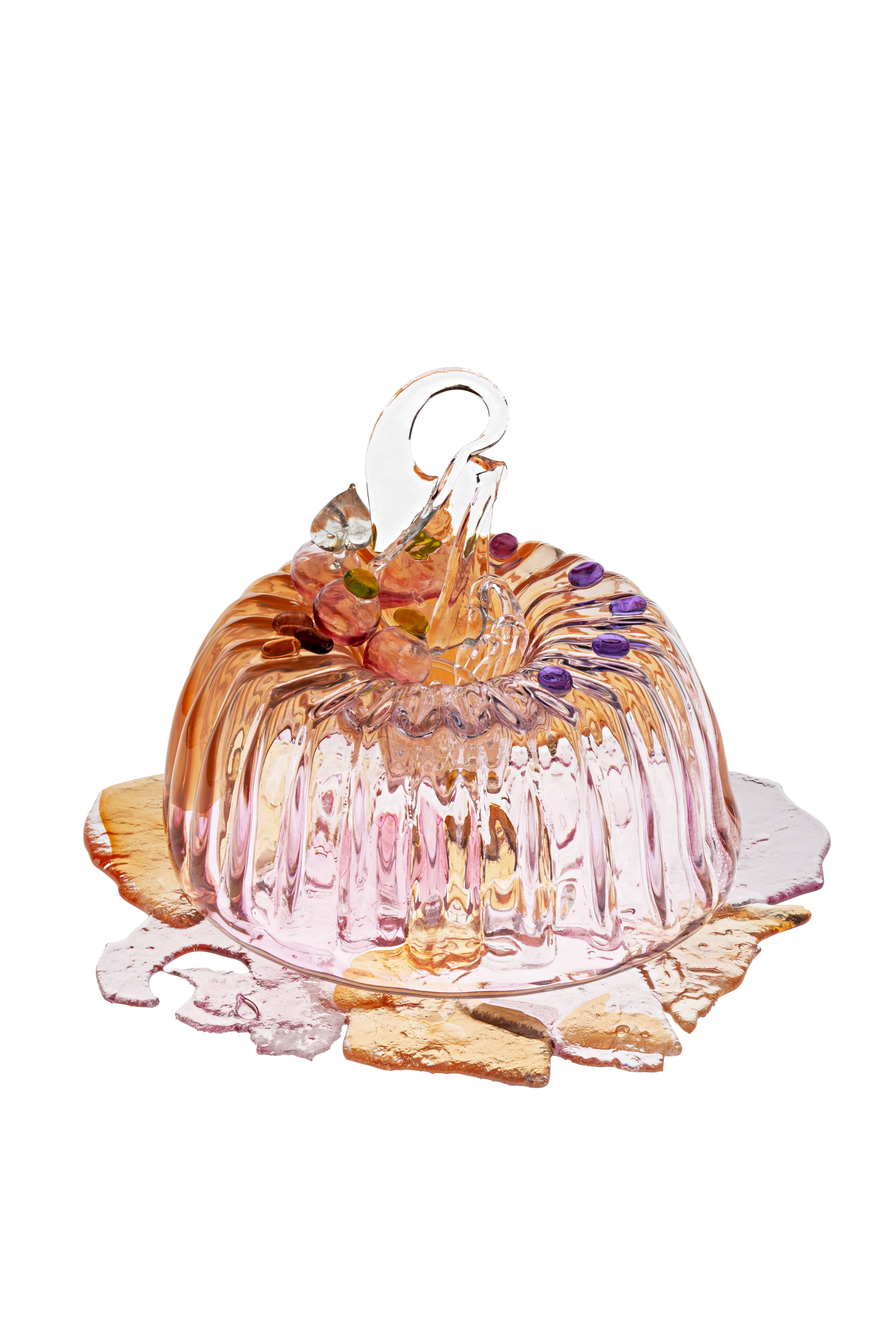
En esta obra, Patrícia Faragone transforma la forma familiar de un pudín en una escultura de vidrio llena de color, brillo y fantasía.
El vidrio soplado, con sus transparencias y tonalidades rosadas y ámbar, evoca la delicadeza y la sensualidad de los dulces, mientras que los pequeños elementos de colores parecen desbordarse de la superficie.
Entre el humor, la memoria afectiva y la exuberancia, la obra juega con la idea de abundancia y exceso, convirtiendo un objeto cotidiano en una celebración de la imaginación y del placer visual.