
Artur Lescher
Bio
Artur Lescher (São Paulo, 1962) studied philosophy at the Pontifical Catholic University of São Paulo and belongs to the 1980s Generation of Brazilian art. He became known at the 19th São Paulo Biennial (1987) with Aerólito (Aerolite), a large installation in aluminum and plastic. His projects include Inabscência (Inabsence), an inverted dome in the octagon of the Pinacoteca de São Paulo (2012), and the solo exhibition Porticus at the Palais d'Iéna, Paris (2017). In 2025 he received the Zurich Art Prize and presented Entangled Fields at the Museum Haus Konstruktiv in Zurich. His work is in the collections of MALBA, the Museum of Fine Arts, Houston, the Philadelphia Museum of Art, and the Buffalo AKG Art Museum. He lives and works in São Paulo.
Statement
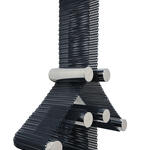
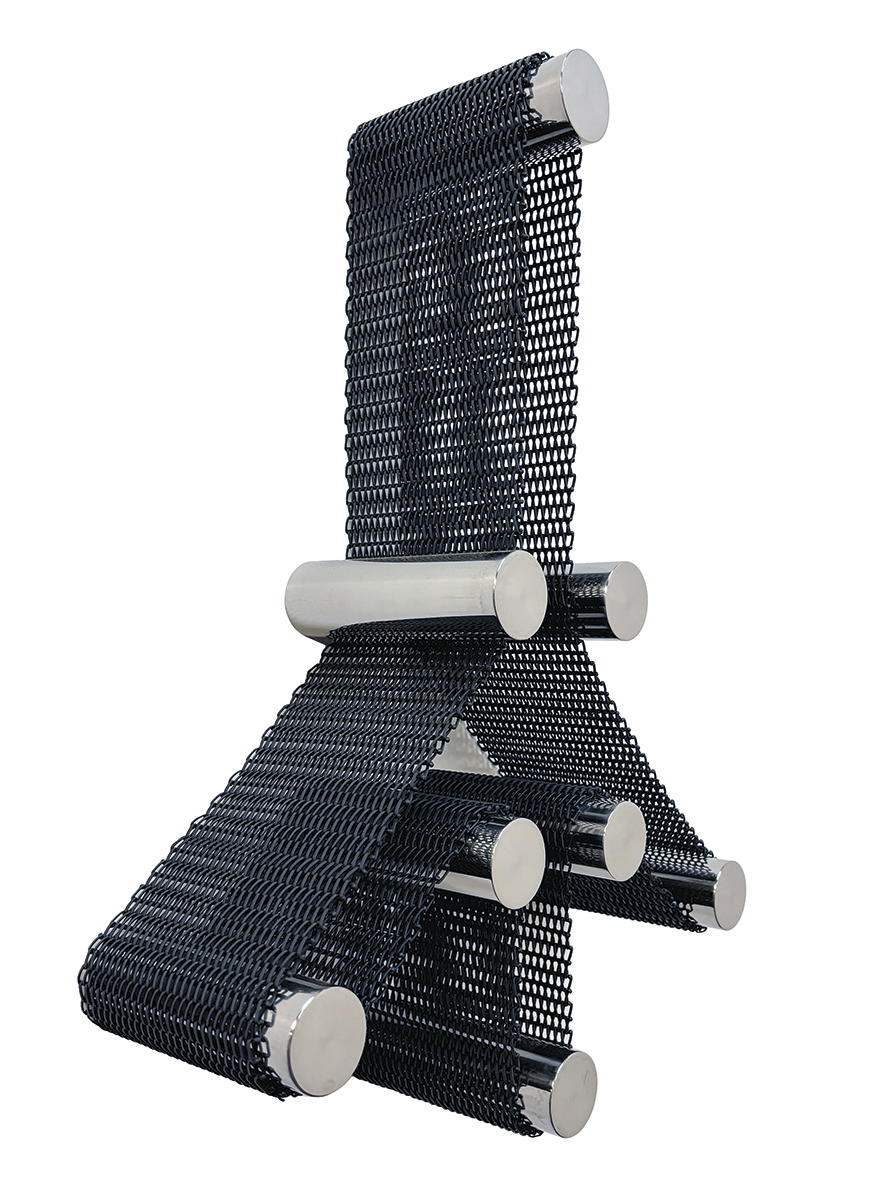
Lescher is a visual thinker of the constructive school, attentive to the ethics of form. His three-dimensional research starts from materials such as wood, brass, copper, felt, steel, and mercury, and from everyday instruments—rulers, set squares, plumb lines, pantographic mechanisms—that he frees from their utilitarian function. He studies the conditions of each space to compose dynamic equilibria of scale, weight, and volume, making the viewer an interlocutor of his geometry. Between stable and flexible solids, his work sustains a project of abstraction in process, in dialogue with architecture and motion.
Additional information
Toma la forma del símbolo de la paz, diseñado en 1958 por el británico Gerald Holtom para el movimiento antinuclear: un círculo que combina las letras N y D del alfabeto de banderas de semáforo («Desarme Nuclear»), y que el propio Holtom también describió como una figura de desesperación, a la manera del hombre ejecutado en «El 3 de mayo» de Goya. Realizada en acero inoxidable y acero galvanizado, la obra forma parte de la práctica artística de Lescher, caracterizada por esculturas de equilibrio y péndulos que exploran la tensión entre el peso y la suspensión.
It takes the form of the peace symbol, designed in 1958 by the Briton Gerald Holtom for the anti-nuclear movement: a circle that combines the letters N and D of the semaphore flag alphabet (“Nuclear Disarmament”), and which Holtom himself also described as a figure in despair, in the manner of the executed man in Goya’s “The Third of May.” In stainless steel and galvanized steel, the piece belongs to Lescher’s practice, marked by sculptures of balance and pendulums that explore the tension between weight and suspension.