
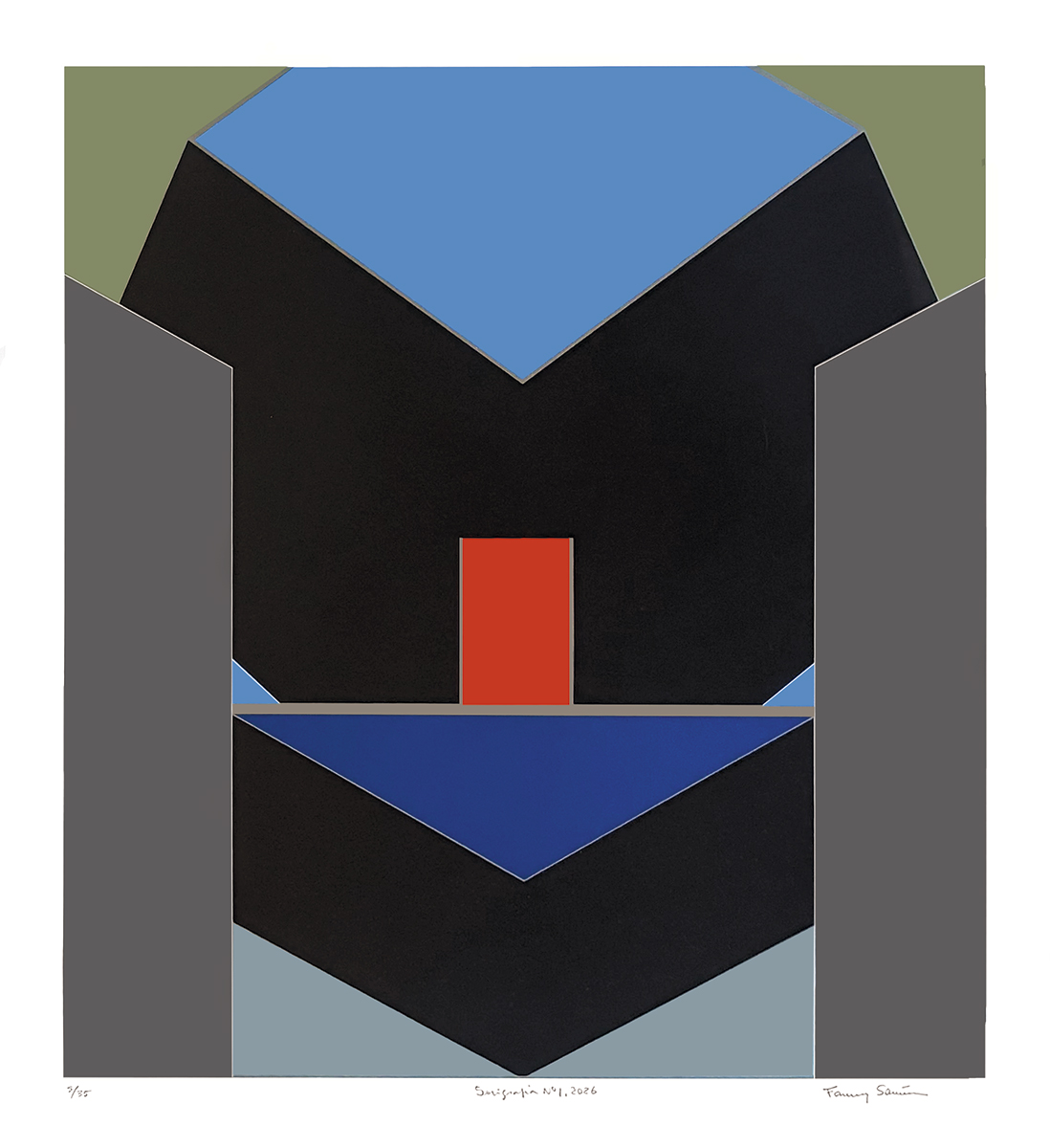
Fanny Sanín
Bio
Fanny Sanín (Bogotá, 1938) studied at the Universidad de los Andes and graduated in 1960 as one of the first three graduates of its art school. After living in the United States, Monterrey, London, and Mexico City, she settled in New York in the 1970s. Her first solo show in Colombia was at the Museo de Arte Moderno de Bogotá (1965), where she held her first retrospective in 1987. Her Acrylic No. 4 won a prize at the Coltejer Biennial (1970). She took part in the Aichi Triennale (2022) and the Venice Biennale (2024) with her Oil No. 7 (1969). In 2025, Americas Society in New York devoted Geometric Equations to her, the first institutional survey of her work in the city. Her work is in the collections of the Guggenheim, MFAH, Tate, the Museo Reina Sofía, and several Colombian art museums.
Statement
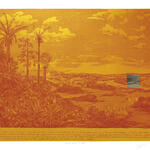
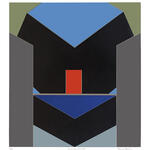
For Fanny Sanín, color and structure always go together. From her earliest abstractions, she moved from organic expressionism to hard-edge and, from 1974, to a symmetrical geometry of vertical, horizontal, and diagonal lines that seeks the essence of form. She mixes colors from the tube until she achieves a personal palette of created tones, at times muted yet never losing their resonance. More than fame or commercial value, she cares about seeing the work, recognizing it, and preserving it: a rigorous abstraction in which each painting is refined until the work emerges.
Additional information
Su lenguaje pasó del expresionismo abstracto de la década de 1960 —lo que Marta Traba denominó “expresionismo orgánico”— al “hard edge” (borde neto, como
lo tradujo el crítico Germán Rubiano), que acabaría definiendo el resto de su obra. A partir de 1974 incorporó la simetría como principio estructural. “El color y la forma siempre van de la mano”, explica la artista, quien, aunque trabaja con colores directamente del tubo, los mezcla hasta lograr una paleta totalmente propia. Además de sus pinturas sobre lienzo, Sanín trata el papel como un soporte autónomo, con la misma disciplina y los mismos estudios preliminares, no como un boceto preparatorio, sino como una composición en sí misma.
Her language moved from the abstract expressionism of the 1960s, what Marta Traba called “organic expressionism,” to “hard edge” (borde neto, as the critic Germán Rubiano translated the term), which would come to define the rest of her work. From 1974 she incorporated symmetry as a structural principle. “Color and form always go together,” explains the artist, who, although she works with colors straight from the tube, mixes them until she achieves an entirely her own palette. In addition to her paintings on canvas, Sanín treats paper as an autonomous support, with the same discipline and the same preliminary studies, not as a preparatory sketch but as a composition in itself.

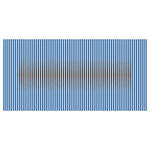
2.5 x 4m / 98.4 x 157 in