
Hugo Demarco
Bio
Hugo Rodolfo Demarco, Argentine-born French painter, was born in Buenos Aires on July 13, 1932, and died in Aubervilliers, Paris, on November 28, 1995. He trained at the Escuela Nacional de Bellas Artes in Buenos Aires, graduating in 1957, and taught painting and
design until his departure for Europe. In 1959 he moved to Paris alongside his former classmates Julio Le Parc and Horacio García Rossi, joining the community of expatriate Latin American artists that included Jesús Rafael Soto, Antonio Asis, and Carlos Agüero,
among others. In 1960 he took part in founding the GRAV (Groupe de Recherche d’Art Visuel) together with Le Parc, Soto, François Morellet, and Vera Molnár, among others, and in 1971 he joined the Position group, made up of Argentine geometric artists living in Paris.
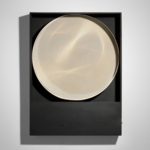
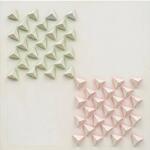
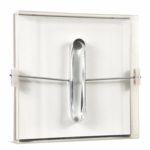
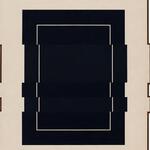
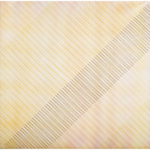
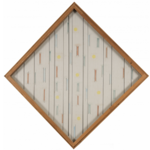
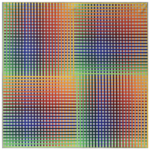
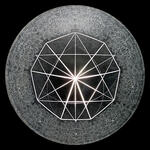
His consecration as a reference of kinetic art was not an isolated event, but rather the culmination of a search centered on light, color, and movement. Demarco was one of the pioneers in conceiving the artwork as a device that deceives and stimulates the viewer’s
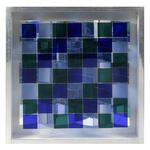
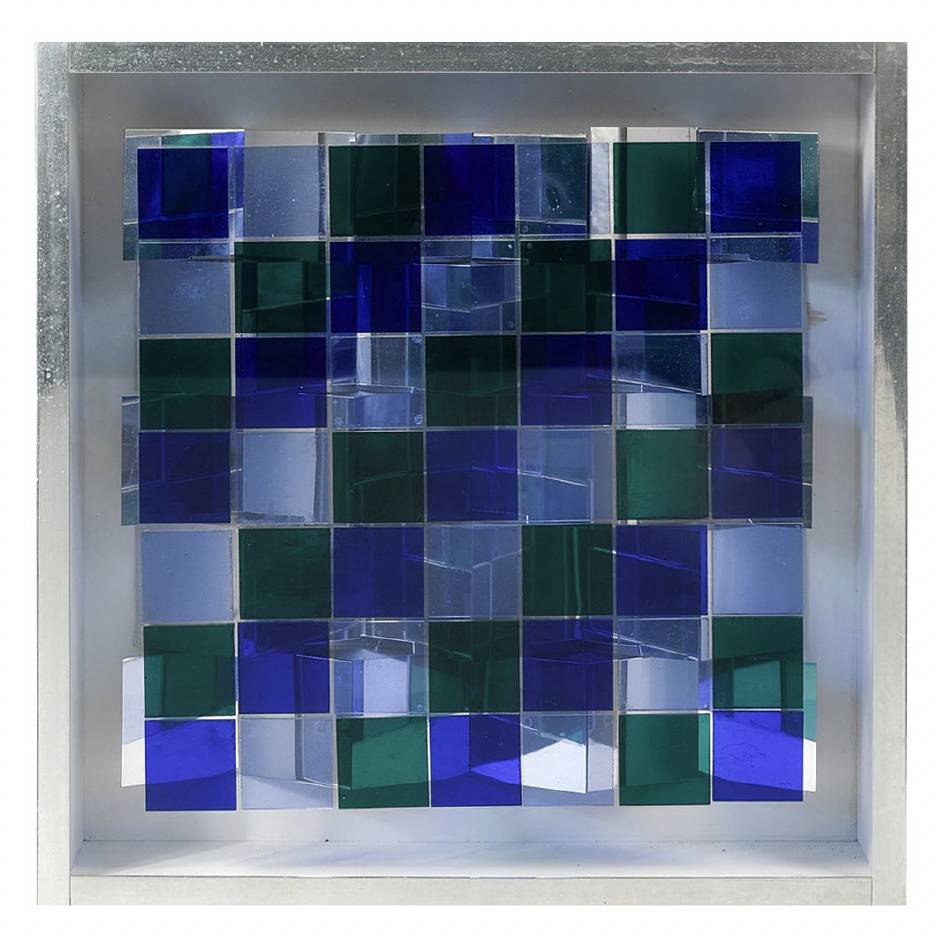
perception, using hidden motors, mirrors, ultraviolet light, and prisms that reflected light to generate optical vibrations and virtual displacements. His work was characterized by creating “very active structures, in spite of the simplicity of their patterns,” combining form, color, texture, and rhythm to produce virtual volumes and movements, as well as a tension between the real and the unreal. Beginning with the Espace Dynamique series, he moved from the flat surface to cubic volume, integrating boxes with superimposed grids that required the viewer’s movement to complete the visual experience.
In the decades that followed, Demarco maintained a prolific output and a constant international presence, with solo exhibitions at Galerie Denise René in Paris (1961, 1963, 1967) and participation in Documenta IV in Kassel (1968) with kinetic objects. In 1968
he was arrested alongside Le Parc during a union demonstration and deported for several months, an episode that paradoxically increased both artists’ visibility. His work is part of public collections including the Musée d’Art Moderne de Paris, the Centre Pompidou, and the Musée des Arts Décoratifs in Paris, and has been exhibited in institutions in Vienna, Antwerp, Zagreb, Copenhagen, and Krefeld, among other cities . In 2008, his Relief à Déplacement Continuel sold for US$67,000 at a Sotheby’s auction in New York. His death, at the age of 63, closed a career that positioned him as one of the great names of Latin American kinetic art in Europe.
Statement
His consecration as a reference of kinetic art was not an isolated event, but rather the culmination of a search centered on light, color, and movement. Demarco was one of the pioneers in conceiving the artwork as a device that deceives and stimulates the viewer’s
perception, using hidden motors, mirrors, ultraviolet light, and prisms that reflected light to generate optical vibrations and virtual displacements. His work was characterized by creating “very active structures, in spite of the simplicity of their patterns,” combining form, color, texture, and rhythm to produce virtual volumes and movements, as well as a tension between the real and the unreal. Beginning with the Espace Dynamique series, he moved from the flat surface to cubic volume, integrating boxes with superimposed grids that required the viewer’s movement to complete the visual experience.
Additional information
Editions Denise René, 50 ejemplares.